UPS ngoài trời
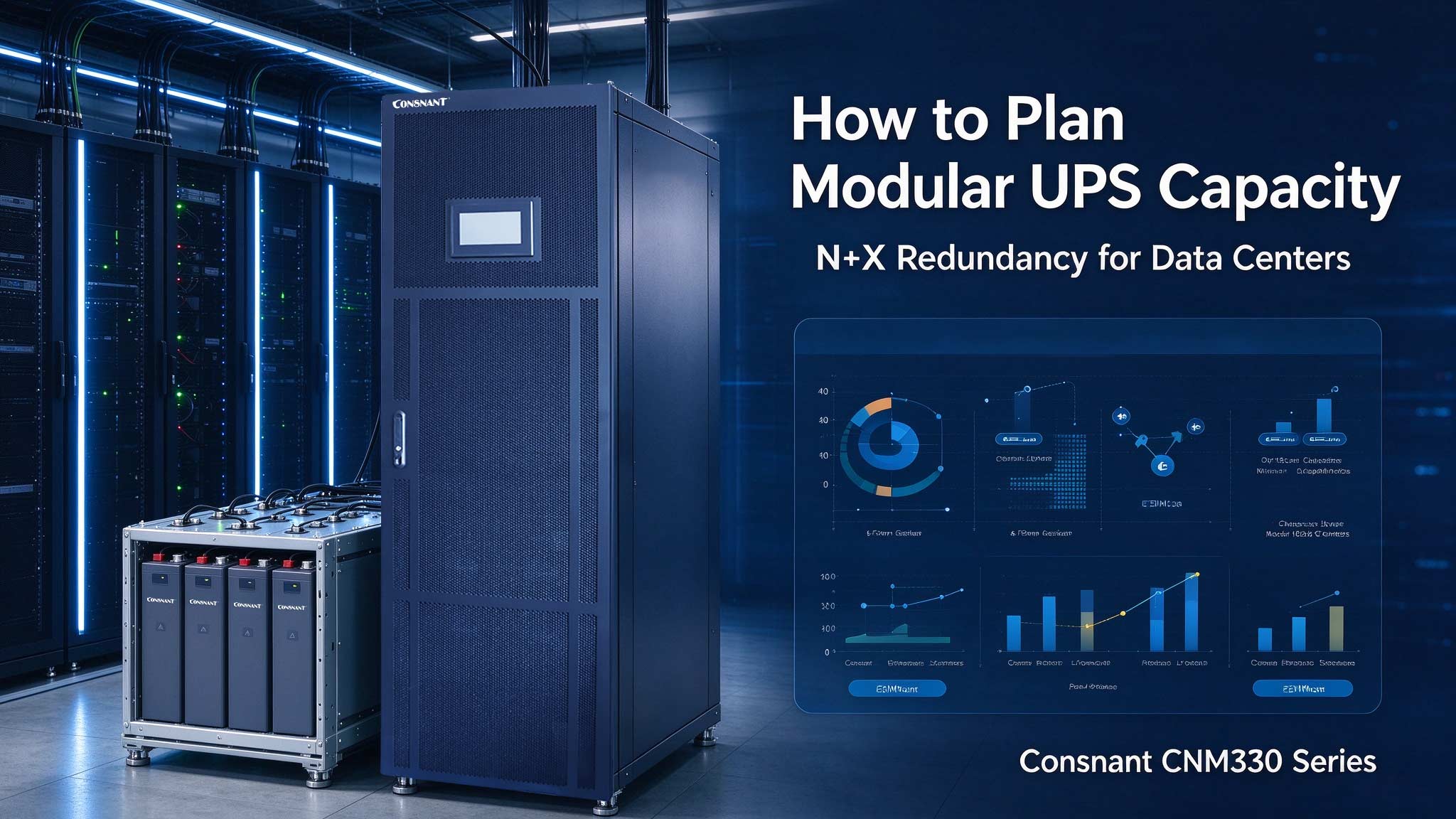
  • How to Plan Modular UPS Capacity and N+X Redundancy for a Data Center? How to Plan Modular UPS Capacity and N+X Redundancy for a Data Center? Nov 02, 2026
    Modern enterprise, colocation and AI‑powered data centers demand flexible, high‑availability uninterruptible power supplies. Modular UPS systems allow incremental capacity expansion and built‑in module‑level N+X redundancy, which outperforms traditional monolithic UPS for fast‑growing IT environments. However, improper capacity calculation or wrong redundancy configuration will cause waste of investment, low operating efficiency or hidden risks of power outage. This article walks you through practical workflows for modular UPS sizing and N+X redundancy design, with real‑world reference to Consnant CNM330 series modular online UPS for data‑center‑grade power protection. Step1: Calculate Real Critical IT Load (Avoid Over‑Sizing or Under‑Sizing) Capacity planning must start from measured real‑world load instead of theoretical nameplate value. Many data‑center projects over‑provision UPS capacity blindly and suffer poor partial‑load efficiency. Sum up critical real power (kW), not just kVA. Include servers, storage, network switches, and also UPS‑supported cooling equipment. For AI GPU racks, use sustained operating power instead of peak instantaneous value. Apply diversity factor: Not every rack runs at full power simultaneously. Typical diversity factor: General enterprise racks: 0.7‑0.85 AI / GPU intensive racks: 0.9‑1.0 Storage array racks:0.8‑0.9 Reserve reasonable future growth margin: Keep the normal operating load within 60%‑80% of total UPS usable capacity. This range balances system efficiency and expansion space. Important note: Do NOT double‑count redundancy capacity as growth headroom. Redundancy modules are for fault tolerance, not for future IT load growth. Consnant CNM330 modular UPS adopts 50 kW high‑density hot‑swap power module, supports flexible capacity stacking from 50 kW up to 600 kW per cabinet, matching phased deployment of small‑medium IDC and large‑scale AI data centers. Step2: Understand N, N+1, N+2, N+X Redundancy for Modular UPS N+X redundancy means deploying N working modules for carrying real‑time load, plus X spare redundant modules. X stands for quantity of backup modules that can bear load when modules fail or are pulled out for maintenanceSchneider ...。 N configuration: Exactly enough modules for present load, zero spare. No fault tolerance. Only suitable for non‑critical edge sites. N+1: 1 spare redundant module. If one module fails or needs hot‑swap maintenance, remaining N modules can fully support critical load. Fits Tier‑II / basic Tier‑III enterprise data centers, most popular cost‑effective solution. N+2: Two spare modules. Tolerate two‑module simultaneous failure or maintain two modules at the same time. Target for high‑reliability Tier‑III / Tier‑IV mission‑critical colocation and financial data centers. 2N / 2(N+1): Dual independent UPS bus architecture. Each bus can independently bear full critical load, highest fault‑tolerance for Tier‑IV facilities. Consnant CNM330 series supports configurable N+X redundancy via LCD touch screen. System will trigger alarm when load exceeds redundancy protection threshold, and can reach system availability up to 99.999% under N+2 setup, MTBF up to 250,000 hours. Power modules support online hot‑swap: technicians replace faulty modules without shutting down IT loads. Up to 4 cabinets can be paralleled for larger‑scale deployment. Step3: Key Factors to Determine Your X Value in N+X Before locking your redundancy scheme, evaluate these four dimensions: Uptime Tier requirement: Match Uptime Institute Tier standards. Tier‑III requires concurrent maintainability; Tier‑IV demands fault‑tolerant power path. Business outage loss: How much financial loss will be caused by power interruption? Financial, medical and core AI computing facilities usually choose N+2 or higher. On‑site maintenance condition: If local engineer response is slow, increase X to reduce maintenance risk window. Total‑Cost‑of‑Ownership(TCO): Each additional redundant module raises CAPEX, but lowers risk of downtime loss. Balance reliability and investment budget. Common Pitfalls in Modular UPS Capacity & Redundancy Design ❌ Confuse kVA and kW, ignore actual output power factor. Modern IT loads draw real power(kW). Consnant CNM330 reaches output power factor 1.0 to deliver more real power within same cabinet footprintConsnant. ❌ Treat redundant X‑modules as expansion capacity. When IT load grows, you still need to add working N‑modules, cannot consume redundancy spare capacity. ❌ Run modular UPS at ultra‑low load (<30% rated). Too‑light load reduces overall system efficiency. Modular UPS should shut idle redundant modules properly if supported. ❌ Ignore battery matching after UPS capacity upgrade. After adding power modules, verify charging current, battery bank voltage and backup runtime together. Consnant CNM330 equips intelligent battery management system with adaptive charging current adjustment for different battery groups. Practical Configuration Example for Consnant CNM330 Modular UPS Scenario: Enterprise Tier‑III data center, real critical IT load = 150 kW, 50 kW per power module. Minimum working N modules = 3 units (3 × 50 kW =150 kW) Require N+1 redundancy → total installed modules: 4 units, total cabinet capacity:200 kW Normal operating load rate: 150÷200 =75%, falls within optimal 60‑80% operating window. If upgrade to high‑security financial data center requirement, switch to N+2: total 5 modules (3+2), total capacity 250 kW. Multiple CNM330 cabinets support parallel expansion, so data centers can purchase initial modules matching current load and add power modules later as business expands, avoiding large‑sum one‑time upfront investment. Additional Site Checks Before Final Deployment Confirm cabinet floor load, rack space, ventilation and heat dissipation condition for modular UPS cabinet. Confirm communication interface: SNMP, Modbus‑TCP, dry‑contact alarm for integrating into data center DCIM monitoring platform. Consnant CNM330 supports above industrial standard interfaces. Validate backup runtime requirement, select proper VRLA or lithium‑ion battery configuration. Conclusion Modular UPS brings outstanding scalability and redundancy advantages, yet reliability does not simply come from buying more modules. Correct workflow: measure real IT load → set reasonable operating load percentage → define N working modules → select X redundancy number according to tier & business risk → verify battery, monitoring and site environment. Consnant CNM330 modular UPS series provides flexible N+X redundant architecture, hot‑swappable power modules and high power‑density design, helping data‑center operators achieve phased construction and balanced TCO between reliability and cost. FAQ Q1: Is N+1 always enough for Tier‑III data center? A1: Not absolutely. N+1 satisfies concurrent maintainability on module‑level, but you still need to check distribution path, bypass and battery system design to fully meet Tier‑III criteria. Q2: Can I add redundant modules later after the modular UPS cabinet is deployed? A2: Yes for Consnant CNM330 series. Empty slots inside cabinet reserve space for future hot‑swap power‑module insertion, no cabinet replacement required. Q3: What is the difference between module‑level N+X and traditional whole‑unit N+1 parallel? A3: Modular N+X implements redundancy inside one cabinet via power modules, smaller footprint, maintenance without whole‑unit shutdown; traditional N+1 parallel uses complete independent UPS cabinets, fits 2N dual‑bus large‑scale architecture. Q4: Does CNM330 modular UPS support lithium‑ion battery?   A4: Yes. The intelligent charging algorithm supports both lead‑acid VRLA and lithium‑iron phosphate battery banks, with adjustable charge parameters.
  • Replacing an Industrial UPS: What Information Should a Plant Gather Before Selecting a Replacement? Replacing an Industrial UPS: What Information Should a Plant Gather Before Selecting a Replacement? Oct 28, 2026
    For manufacturing plants, chemical facilities, water treatment sites and process automation workshops, the industrial UPS protects mission-critical loads: DCS control systems, PLC hosts, sensors, safety interlock devices and monitoring instruments. An aging UPS faces rising failure risk, spare part shortages and low efficiency. Rushing into replacement without a complete data survey often leads to mismatched capacity, incompatible wiring, insufficient backup runtime or expensive rework. Before selecting a replacement industrial online UPS, maintenance and electrical teams must collect structured site data. This checklist helps you define requirements clearly and select a reliable industrial UPS solution such as Consnant CNG low-frequency industrial UPS and CNH high-frequency industrial UPS series. 1. Existing UPS & Load Profile Data Start by auditing the current UPS and real load conditions, not only the nameplate values. Old UPS model, rated kVA/kW, output power factor, phase configuration (3/3, 3/1, 1/1), topology (online double conversion) Actual measured load (not just nameplate sum): steady-state load, inrush current from motors, periodic surge load Critical load list: DCS, PLC, emergency instruments, SCADA, actuators; separate non-critical loads that can be removed from the UPS bus Load tolerance: voltage sag tolerance, harmonic sensitivity, whether zero transfer time is mandatory Future expansion margin: 20%–30% spare capacity is recommended for new production lines or additional control cabinets Consnant industrial UPS supports output power factor 1.0, which delivers more real power for modern switching power loads common in automation control rooms. The CNG330 low-frequency industrial UPS is designed to withstand heavy inrush and short-circuit events typical of factory environments. 2. Grid & Electrical Interface Information Industrial sites usually suffer unstable grids: voltage flicker, frequent sags, harmonics and phase imbalance. These parameters decide the acceptable input window, rectifier type and harmonic requirements. Nominal voltage: 380/400/415VAC, 220/230VAC; actual long-term measured input voltage range Frequency range, grid THDi, harmonic source location (VFD, welding machines) Input and output wiring: cable size, existing bypass path, maintenance bypass, single-line diagram Protection coordination: upstream MCCB rating, earth fault scheme, short-circuit capacity at the power room Local compliance standards: IEC 62040, CE, ISO and site internal electrical codes Consnant high-frequency CNH series adopts ultra-wide input voltage range, which reduces battery discharge frequency and extends battery life for sites with poor grid quality. The 12-pulse rectifier option suppresses low-order harmonics for harmonic-sensitive process plants. 3. Backup Runtime & Battery System Requirements Battery is the biggest variable in industrial UPS TCO. Do not default to the old runtime. Required backup time: short ride-through (5–15 min) for orderly shutdown; long runtime (30 min to several hours) for continuous process Battery type compatibility: lead-acid VRLA or LiFePO4 lithium battery Existing battery cabinet size, DC voltage, charging current limits Battery environment: temperature, ventilation, fire control rules, battery recycling requirements Recharge time target after outage Consnant’s intelligent battery management system automatically switches float charge and equalized charge, slowing battery aging and extending battery service life by over 40%. External battery cabinets can be configured flexibly to meet customized backup duration. 4. Physical Site & Environmental Constraints Many UPS retrofit projects fail because engineers only check drawings instead of the real room conditions. UPS room dimensions, floor load capacity, door width, lifting path, elevator limits Ambient temperature, humidity, dust, corrosive gas, condensation risk; IP protection requirement Heat dissipation: air conditioning capacity, ventilation route, noise limit for control building Installation footprint: traditional tower or compact rack/modular layout Working window for replacement: whether live cutover is needed to avoid production stop 5. Communication, Monitoring & Maintenance Specifications Modern industrial UPS must integrate into plant SCADA and centralized monitoring platforms. Required communication protocols: Modbus-RTU, Modbus-TCP, SNMP, dry contact alarm Remote monitoring platform, local HMI display requirement, fault alarm notification method Maintenance access: front service, hot-swap module, online parallel expansion capability Service expectation: local after-sales support, spare parts lead time, preventive maintenance plan Consnant industrial UPS supports standard industrial communication interfaces and parallel redundancy. Multiple units can run in parallel for N+1 redundancy, enabling online capacity expansion without shutting down critical control systemsMade-in-Ch.... 6. Budget, TCO & Cutover Risk Plan Capital budget and long-term TCO comparison: efficiency loss of old UPS, battery replacement cycle, maintenance cost Cutover strategy: hot swap, temporary bypass UPS, scheduled shutdown window Disposal plan for old UPS and waste batteries following local environmental regulations Matching Consnant Industrial UPS Series After Data Collection After you gather all the above information, you can match the correct product family: CNG Low Frequency Industrial Online UPS: for heavy industry, harsh grid, high overload, DCS/boiler/chemical control systems CNH High Frequency Industrial Online UPS: compact footprint, high efficiency, for automation workshops, intelligent factory control rooms Modular UPS: for phased expansion, N+1 redundant power rooms, data and central control centers Final Tips for Plant Teams UPS replacement is not a simple “same-for-same swap”. Old units may be oversized or undersized for today’s load profile. A complete site survey report allows your UPS supplier like Consnant to provide an optimized quotation, correct cabinet layout and safe cutover scheme. FAQ Q1: Can I directly replace the industrial UPS with the same kVA as the old one? A1: Not recommended. You need to measure the real running load, check power factor and add expansion margin. The old UPS may run at low load with poor efficiency or be overloaded by newly added control equipment. Q2: What is the advantage of low-frequency industrial UPS for process plants? A2: Low-frequency UPS has stronger overload and short-circuit tolerance, better anti-interference performance, suitable for sites with motor loads and frequent grid disturbances. Q3: Does Consnant industrial UPS support lithium battery? A3: Yes. Consnant industrial online UPS is compatible with lead-acid and LiFePO4 batteries, with adjustable charging curves for different battery chemistries.
  • What Maintenance Does an Industrial UPS Need? How Can Factories Reduce Downtime and Battery Failures? What Maintenance Does an Industrial UPS Need? How Can Factories Reduce Downtime and Battery Failures? Oct 26, 2026

    Industrial online UPS is the power safety backbone for petrochemical plants, power plant DCS systems, production lines and lab test equipment. Unplanned UPS failures cause costly production shutdowns, and 75‑80% of industrial UPS outages root in insufficient maintenance and premature battery faults. Even high‑grade hardware such as the CONSNANT CNI310 & CNI330 series industrial online UPS (10‑300KVA, IP42/IP54 rated, ISO‑IEC‑CE certified) cannot escape wear‑and‑tear in dusty, high‑temperature factory environments. This blog breaks down mandatory maintenance items, explains battery failure triggers, and shares actionable strategies to minimise factory downtime. Core Routine Maintenance for Industrial Online UPS Industrial UPS maintenance covers three major blocks: power cabinet hardware, battery bank, and monitoring & bypass system. Follow a time‑based inspection cycle: daily visual check, quarterly deep inspection, annual full functional test. 1.Main Cabinet & Power Electronics Maintenance The main cabinet contains rectifier, inverter, cooling fans, static bypass switch and touch‑screen HMI. For CONSNANT industrial UPS main cabinet and separate bypass cabinet: Daily: Check touch‑screen alarm logs, running status of fans, indicator lights. Confirm no abnormal noise or overheating warnings. The built‑in monitoring system records 256 historical events for fault traceabilityConsnant. Quarterly: Clean dust from air filters and ventilation grilles. Dust accumulation blocks heat dissipation and triggers over‑temperature shutdown. Inspect cabinet wiring terminals for loose connections or oxidation. Annually: Complete bypass transfer test. Verify seamless switch between mains, inverter and maintenance bypass. Check capacitor ageing status, update UPS firmware if official releases are available. Note: Maintenance bypass cabinet is critical for hot servicing without cutting off critical loads, widely used on CNI330 100‑300KVA large‑capacity industrial UPS models. 2.Battery System Maintenance (Most Failure‑Prone Part) Statistics show most UPS emergency failures happen on batteries. VRLA batteries degrade fast under high heat. The ideal ambient temperature is 20‑25°C. Every +10°C temperature rise roughly halves battery service life. Monthly: Monitor battery temperature, float voltage via UPS touch‑screen or remote MODBUS monitoring. Remove obstacles blocking battery cabinet airflow. Quarterly: Test internal resistance of each battery cell. Replace cells when impedance exceeds 50% of factory baseline; inspect terminals for corrosion and retighten bolts to manufacturer torque specs. Every 2‑4 months: Perform shallow load discharge (30% depth of discharge) to prevent sulphation on battery plates, especially for UPS running long‑term on mains mode without actual backup dischargeConsnant. Annually: Conduct full capacity discharge test. If remaining capacity drops below 80% rated value, plan battery group replacement. Do NOT replace single individual battery in a string; replace the whole battery pack togetherConsnant. 3.Environmental & Site Maintenance Industrial factories feature dust, vibration, humidity and wide temperature swings. Keep UPS room ambient temperature stable 20‑25℃, avoid direct sunlight or heat source radiation. Maintain IP rating integrity: IP42 / IP54 cabinets (CONSNANT optional grade) require door seals intact; do not leave cabinet doors open for long periods. Keep ground connection reliable, avoid corrosive gas near UPS and battery cabinets. Why Do Industrial UPS Batteries Fail Prematurely? Common root causes: High operating temperature: #1 cause of early battery ageing in factories. Long‑term float charging without periodic discharge → plate sulphation. Loose terminals, corrosion, poor ventilation. Mismatched charging parameters, wrong float voltage settings. Delayed replacement past design service life. CONSNANT CNI310 / CNI330 industrial UPS supports battery temperature compensation charging, automatically adjusting float voltage according to battery temperature to reduce over‑charge risks, lowering premature battery failure probabilityConsnant. Practical Strategies for Factories to Reduce Unplanned Downtime 1.Build Preventive Maintenance Schedules Critical sites (power plant DCS, petrochemical safety systems): quarterly inspection + annual comprehensive test. General production workshops: semi‑annual inspection + annual discharge test. Harsh dusty/high‑temperature workshops: shorten inspection cycles. 2.Make Full Use of UPS Intelligent Monitoring Functions CONSNANT industrial online UPS supports 7‑inch touch screen, dry‑contact alarm, RS485 / MODBUS remote communication, real‑time tracking of voltage, frequency, load rate, battery SOH(state‑of‑health). Configure early warning alerts to capture hidden faults before blackout occursConsnant. 3.Reasonable System Redundancy & Capacity Sizing Reserve 20‑30% load margin when selecting UPS capacity. Avoid running UPS close to full load continuously. For mission‑critical facilities, adopt N+1 redundant configuration to achieve maintenance without production haltConsnant. 4.Proactive Consumable Replacement Do not wait for complete failure. Schedule battery, fan and capacitor replacement before end‑of‑life. For CONSNANT series UPS, modular power unit design shortens mean repair time under 0.5 hours when component replacement is neededConsnant. Frequently Asked Questions Q1: Can maintenance‑free batteries skip UPS battery inspection? A: “Maintenance‑free” only means no liquid refilling. Sealed VRLA batteries still require regular voltage, impedance and temperature checks, they will still age and fail without monitoring. Q2: What risk if I skip UPS regular maintenance? A: Hidden battery degradation, cooling failure, bypass switch malfunction. When real mains outage arrives, your UPS may fail to deliver backup power, triggering costly factory downtime and safety risks. Conclusion Industrial UPS is not “set‑and‑forget” equipment. Systematic preventive maintenance greatly lowers downtime risk and extends total system lifespan. For power plant DCS control, boiler safety monitoring, petrochemical and production‑line protection, the CONSNANT industrial online UPS portfolio delivers robust industrial‑grade hardware; paired with standardised maintenance workflow, it secures continuous power for your critical assets. If you are looking for industrial‑grade online UPS solutions ranging from 10KVA‑300KVA for three‑phase‑in three‑phase‑out / three‑phase‑in single‑phase‑out scenarios, explore our CNI330 and CNI310 series.
  • CONSNANT Outdoor UPS 1K: Road Monitoring Project in Burkina Faso CONSNANT Outdoor UPS 1K: Road Monitoring Project in Burkina Faso Oct 12, 2026
    Project Location: Burkina Faso Industry: Municipal Road Security & Surveillance Product: 1kVA Pole-mounted Outdoor UPS   Application: Backup Power for CCTV Surveillance   CONSNANT 1KVA pole-mounted Outdoor UPS was deployed for road surveillance in Burkina Faso. This all-in-one outdoor power cabinet mounts directly on camera poles, delivering uninterrupted power for monitoring cameras and transmission gear. It effectively addresses local grid outages & voltage fluctuations, adapting to West Africa’s hot, dusty tropical climate with simple installation and low maintenance.   Have outdoor surveillance, traffic or telecom projects facing unstable power? Contact CONSNANT team to get your customized outdoor UPS power proposal.    
  • New CNG112 Series Low Frequency Online UPS for Global IT & Industrial Critical Power Projects New CNG112 Series Low Frequency Online UPS for Global IT & Industrial Critical Power Projects Jun 06, 2026
    Introduction CONSNANT officially releases the brand-new CNG112 Series 4~20KVA Low Frequency Online UPS, optimized for single-phase critical power demand across global IT rooms, industrial automation, commercial office and small-scale data center projects. As an upgraded single-in single-out Low Frequency UPS, CNG112 integrates built-in isolation transformer, full-circuit protection and intelligent monitoring, delivering stable, clean backup power for precision electronic equipment in unstable grid environments worldwide.   Core Product Advantages of CNG112 4-20KVA Low Frequency UPS 1. Industrial Low-Frequency Transformer Design Equipped with internal isolation transformer as standard configuration, the CNG112 series features outstanding anti-surge and anti-interference performance, effectively filtering grid harmonic, voltage spike and waveform distortion. It remains stable in regions with poor power quality, a core advantage compared with conventional high-frequency UPS for harsh grid overseas projects. 2. Comprehensive Multi-layer Load Protection Complete protection mechanism including overvoltage, undervoltage, overload, short-circuit, over-temperature and lightning surge protection. When abnormal grid fluctuation or sudden blackout happens, the UPS instantly switches to battery mode to avoid unexpected shutdown and hardware damage of servers, PLC control hosts and monitoring equipment. 3. Optimized Battery Management System Customized charging algorithm for lead-acid storage batteries, realizing floating charge & equalized charge automatic switching, reducing overcharging damage and prolonging the whole battery service life. Flexible external battery configuration supports customizable backup runtime from tens of minutes to several hours to match diverse client project demands. 4. Intelligent Human-Machine & Remote Management Large LCD real-time display for input voltage, output parameter, battery status and fault code, facilitating on-site inspection and daily maintenance. Optional SNMP/RS485 communication module enables remote centralized monitoring via PC or cloud platform, ideal for centralized management of multi-set UPS deployed in branch office or distributed IT rooms. 5. Compact Mobile Cabinet Structure Equipped with wear-resistant universal casters, the vertical compact cabinet is easy for transportation, site placement and layout adjustment, saving installation space for narrow equipment room and small control cabinet scenarios.   Wide Application Scenarios of CNG112 Series The 4KVA~20KVA full power range covers diversified critical load fields: ✅ Small & medium-sized IDC computer room, server workstation and network equipment ✅ Industrial automation control system, PLC cabinet and production monitoring equipment ✅ Hospital outpatient office, banking terminal and retail commercial POS system ✅ Government office building, security monitoring and communication terminal equipment Perfectly fit overseas small-scale engineering bidding, system integrator matching and end-user facility renovation projects across Southeast Asia, Middle East, Africa and other emerging markets with unstable local power supply.   Why Choose CONSNANT CNG112 Low Frequency UPS? With decades of R&D and manufacturing experience in uninterruptible power supply, CONSNANT strictly implements ISO production standard for the whole CNG112 production line, from raw material incoming inspection to finished machine aging test. Besides reliable product quality, we provide global localized after-sales support, customized technical solution and flexible OEM/ODM service for worldwide distributors and project contractors. Ready to explore CNG112 power solution for your upcoming IT projects? Contact our sales team to get detailed datasheet, quotation and free technical consultation.  
  • CONSNANT CNG330 600KVA low-frequency online UPS applied in factories CONSNANT CNG330 600KVA low-frequency online UPS applied in factories May 22, 2026
    In today’s fast-paced manufacturing landscape, even a split-second power interruption can trigger costly production line shutdowns, damage high-value equipment, and lead to massive operational losses. For factories relying on heavy machinery, automated control systems, and continuous production workflows, power stability is non-negotiable. This is where the CONSNANT CNG330 600KVA Low-Frequency Online UPS emerges as the ultimate power protection solution, purpose-built to meet the most demanding industrial power requirements. Why Factories Need Industrial-Grade UPS Solutions Industrial environments are notorious for harsh power conditions: frequent voltage fluctuations, grid surges, harmonic distortion, and high inrush currents from motors, compressors, and welding equipment. Conventional power solutions often struggle to handle these challenges, putting critical operations at risk. The CNG330 series, with its low-frequency transformer-based architecture, is engineered to thrive in these settings, delivering robust, uninterrupted power to keep production moving.   Key Advantages of the CNG330 600KVA UPS for Factory Use 1. Built-in Isolation Transformer for Stable, Clean Power At the heart of the CNG330 lies an integrated isolation transformer, which provides complete electrical isolation from the mains. This feature effectively suppresses grid noise, voltage spikes, and EMI interference, delivering a pure sine wave output that protects sensitive PLCs, CNC machines, and automated control systems from damage. Unlike high-frequency UPS models, the transformer-based design ensures reliable performance even with non-linear and inductive loads common in factories. 2. Superior Overload & Short-Circuit Resistance Factory operations often involve sudden load surges—such as motor startups or heavy machinery activation. The CNG330’s industrial-grade design boasts exceptional overload capacity, capable of withstanding these high inrush currents without tripping. Its robust short-circuit protection ensures that downstream faults are cleared without disrupting power to critical systems, eliminating unplanned downtime caused by minor electrical anomalies. 3. Wide Voltage Input for Harsh Grid Conditions Many factories operate in areas with unstable power grids, where voltage can swing by ±20% or more. The CNG330 supports a wide input voltage range, eliminating the needfor additional stabilizers and ensuring continuous operation even in poor power environments. This adaptability makes it ideal for factories in remote locations or regions with inconsistent power infrastructure. 4. Low Harmonic Distortion & High Power Efficiency With low THDi (Total Harmonic Distortion) and a high power factor, the CNG330 minimizes harmonic pollution and maximizes energy efficiency. This not only reduces the risk of interference with other equipment but also lowers long-term energy costs for the factory, aligning with sustainability goals and operational efficiency targets. 5. Parallel Redundancy for Zero Downtime For factories requiring 100% uptime, the CNG330 supports N+1 parallel redundancy. Multiple units can be connected to share the load, ensuring that even if one UPS requires maintenance or experiences a fault, the remaining units continue to power critical operations. This modular scalability makes it easy to expand power capacity as the factory grows. 6. Low Maintenance & Long Service Life Designed with industrial-grade components and robust cooling systems, the CNG330 is built for durability. Its low-frequency architecture reduces component stress, leading to fewer failures and lower maintenance costs over its lifecycle. Combined with intelligent remote monitoring capabilities, factory managers can track performance, diagnose issues, and perform maintenance proactively, without disrupting production.   Real-World Impact: Protecting Factory Operations Consider a large manufacturing plant running 24/7 automated production lines. A single power flicker could halt production for hours, resulting in lost materials, labor, and revenue. With the CNG330 600KVA UPS in place: Production continuity is guaranteed, even during grid outages or fluctuations. High-value equipment (CNC machines, robotics, control systems) is protected from power-related damage. Operational costs are reduced through energy efficiency and minimal downtime. Safety compliance is maintained for critical systems that rely on stable power.   Conclusion: The CNG330 as Your Factory’s Power Backbone The CONSNANT CNG330 600KVA Low-Frequency Online UPS is more than just a power backup—it’s a strategic investment in your factory’s reliability, productivity, and profitability. Built to withstand the toughest industrial environments, it combines robust performance, efficiency, and scalability to meet the evolving power needs of modern manufacturing. Whether you’re operating a single production line or a sprawling industrial complex, the CNG330 series delivers the peace of mind that comes with knowing your power is always protected.   For more information on how the CNG330 600KVA UPS can be tailored to your factory’s specific power requirements, contact our team today for a customized solution and quotation.
  • CONSNANT cung cấp giải pháp UPS đáng tin cậy và dịch vụ tại chỗ cho nhà máy sản xuất cửa sổ và cửa ra vào Yangon. CONSNANT cung cấp giải pháp UPS đáng tin cậy và dịch vụ tại chỗ cho nhà máy sản xuất cửa sổ và cửa ra vào Yangon. May 06, 2026
     Giải pháp nguồn UPS 250KVA tùy chỉnh cho dự án dây chuyền sản xuất mới của Nhà máy Cửa sổ và Cửa ra vào YangonTừ năm 2018, một nhà máy sản xuất cửa sổ và cửa ra vào lớn tại Yangon, Myanmar, đã tin tưởng CONSNANT đáp ứng nhu cầu điện năng quan trọng của mình, triển khai nhiều bộ thiết bị của chúng tôi. UPS trực tuyến tần số thấp 250kVA Hệ thống (đầu ra ba pha) để bảo vệ thiết bị sản xuất cốt lõi. Gần đây, các kỹ sư dịch vụ của chúng tôi đã đến thăm nhà máy để cung cấp dịch vụ bảo trì và tư vấn UPS toàn diện cho dây chuyền sản xuất mới, củng cố cam kết của chúng tôi về hỗ trợ nguồn điện đáng tin cậy cho đối tác lâu dài của chúng tôi. Môi trường điện lực địa phương đầy thách thứcNhà máy hoạt động trong một khu vực có những hạn chế nghiêm trọng về nguồn điện:• Hạn chế tiếp cận điện lưới: Chỉ có điện lưới từ 4-6 giờ mỗi ngày.• Nhiệt độ hoạt động khắc nghiệt: Nhiệt độ trong xưởng có thể lên tới 42°C.• Bảo vệ tải trọng quan trọng: Các máy ép đùn của nhà máy—cốt lõi của quy trình sản xuất—yêu cầu nguồn điện liên tục để tránh thời gian ngừng hoạt động tốn kém, lãng phí nguyên vật liệu và chậm trễ sản xuất.Những điều kiện này đòi hỏi các giải pháp UPS mạnh mẽ, chịu được nhiệt độ cao, có khả năng cung cấp nguồn điện dự phòng ổn định, thời gian dài trong điều kiện khắc nghiệt. Hệ thống UPS trực tuyến tần số thấp 250kVA của chúng tôi, được chế tạo bằng các linh kiện cấp công nghiệp và có phạm vi nhiệt độ hoạt động rộng, đã liên tục đáp ứng được những yêu cầu này kể từ khi được đưa vào sử dụng. Dịch vụ tại chỗ: Bảo trì & Giải pháp đường dây mớiTrong chuyến thăm, các kỹ sư của chúng tôi đã hoàn thành hai mục tiêu chính nhằm hỗ trợ hoạt động của khách hàng:1. Bảo trì phòng ngừa cho các hệ thống UPS hiện có• Kiểm tra toàn diện và thử nghiệm hiệu năng của các bộ UPS 250kVA đã lắp đặt.• Kiểm tra tình trạng pin, kiểm tra tải giả và hiệu chuẩn hệ thống• Vệ sinh các bộ phận bên trong và kiểm tra hiệu quả hệ thống làm mát, rất quan trọng đối với môi trường xưởng có nhiệt độ cao.• Ghi chép tình trạng hệ thống và đưa ra các khuyến nghị về lịch bảo trì tối ưu.Các biện pháp chủ động này đảm bảo hệ thống UPS hiện có tiếp tục cung cấp nguồn điện dự phòng đáng tin cậy cho các máy ép đùn của nhà máy, giảm thiểu rủi ro sự cố bất ngờ.2. Giải pháp nguồn điện dự phòng tùy chỉnh cho dây chuyền sản xuất mớiPhối hợp chặt chẽ với đội ngũ của khách hàng, các kỹ sư của chúng tôi đã thiết kế một kế hoạch bảo vệ nguồn điện phù hợp cho dây chuyền sản xuất mới:• Đánh giá tải và phân tích nhu cầu điện năng cho thiết bị mới• Đề xuất bổ sung CONSNANT 250kVA UPS trực tuyến tần số thấp các đơn vị, được tối ưu hóa cho nhu cầu vận hành kéo dài của nhà máy.• Hướng dẫn về bố trí lắp đặt, yêu cầu thông gió và tích hợp với cơ sở hạ tầng điện hiện có của nhà máy.Giải pháp này tận dụng những ưu điểm cốt lõi của bộ lưu điện ba pha 250kVA của chúng tôi:• Cấu trúc mạng tần số thấp với khả năng chịu quá tải cao và khả năng thích ứng mạnh mẽ với lưới điện không ổn định.• Thiết kế đạt tiêu chuẩn công nghiệp với khả năng bảo vệ tích hợp chống lại nhiệt độ cao, biến động điện áp và môi trường khắc nghiệt.• Đầu ra ba pha để cung cấp điện năng cân bằng cho các tải công nghiệp như máy ép đùn.• Các tùy chọn thời gian hoạt động có thể mở rộng để phù hợp với nhu cầu vận hành độc lập hàng ngày của nhà máy.Xây dựng quan hệ đối tác lâu dài dựa trên sự tin cậy và hỗ trợ.Dự án này là minh chứng cho cam kết kép của CONSNANT: cung cấp các giải pháp UPS bền bỉ, hiệu suất cao, hoạt động tốt trong môi trường khắc nghiệt, và cung cấp hỗ trợ tại chỗ nhanh chóng để đảm bảo hoạt động của các đối tác diễn ra suôn sẻ.Trong hơn sáu năm qua, hệ thống UPS trực tuyến tần số thấp 250kVA của chúng tôi đã đảm bảo các dây chuyền sản xuất của nhà máy Yangon hoạt động liên tục, ngay cả trong điều kiện điện năng khó khăn nhất. Chuyến thăm bảo trì gần đây của chúng tôi không chỉ kéo dài tuổi thọ của thiết bị hiện có mà còn đặt nền tảng cho sự mở rộng trong tương lai của khách hàng.Tại CONSNANT, chúng tôi không chỉ cung cấp các giải pháp năng lượng mà còn luôn đồng hành cùng khách hàng trong suốt quá trình thực hiện.
  • Trạm biến áp tích hợp thông minh: Hệ thống lưu trữ năng lượng làm mát bằng chất lỏng cho công nghiệp và thương mại Trạm biến áp tích hợp thông minh: Hệ thống lưu trữ năng lượng làm mát bằng chất lỏng cho công nghiệp và thương mại Apr 25, 2026
    Trong bối cảnh chuyển đổi năng lượng toàn cầu và việc đẩy mạnh mục tiêu "giảm phát thải carbon kép", lĩnh vực thương mại và công nghiệp (C&I), với vai trò là mắt xích quan trọng trong tiêu thụ năng lượng và giảm phát thải carbon, đang ngày càng có nhu cầu cấp thiết về năng lượng hiệu quả, an toàn và... giải pháp cung cấp năng lượng thông minhTrạm biến áp tích hợp thông minh kết hợp với hệ thống lưu trữ năng lượng công nghiệp và thương mại làm mát bằng chất lỏng nổi lên như một giải pháp cốt lõi, tích hợp công nghệ chuyển đổi điện năng thông minh, phân phối và lưu trữ năng lượng làm mát bằng chất lỏng. Nó phá vỡ những nút thắt cổ chai của các hệ thống cung cấp và lưu trữ điện năng truyền thống, đồng thời cung cấp sự đảm bảo năng lượng đáng tin cậy, hiệu quả và ít phát thải carbon cho người dùng công nghiệp và thương mại như khu công nghiệp, doanh nghiệp tiêu thụ năng lượng cao và các khu phức hợp thương mại.  Ưu điểm cốt lõi:Tiết kiệm đầu tư♦ Thiết kế hệ thống tích hợp, lắp đặt trước và chuẩn bị trướcviệc vận hành thử, giảm số lượng nhân viên tại chỗ.điều chỉnh.♦ Điều khiển nhiệt độ thông minh bằng AI, nhiệt độ hệ thống Chênh lệch nhiệt độ ≤ 4°C, giảm công suất phụ trợ 30%.sự tiêu thụNâng cấp trải nghiệm người dùng ♦ Thiết kế đầu nối thân thiện với người dùng, phù hợp với nhiều loại dây dẫn. Yêu cầu về thước đo.♦ Giảm đáng kể mức độ tiếng ồn khi vận hành xuống mức thấp nhất là 70dB.Hiệu suất tối đa♦ Chuyển đổi năng lượng hiệu suất cao PCS đa tầng công nghệ nhằm nâng cao khả năng sạc và xả của hệ thống.Hiệu suất lên đến 90%.♦ Các thuật toán tối ưu hóa AI đám mây cung cấp khả năng ra quyết định dựa trên cơ sở dự báo độ chính xác cao cho các hệ thống phức tạp. hoạt động và giao dịch thị trường điện, có thể tăng doanh thu hàng năm từ 15% đến 20% và rút ngắn thời gianChu kỳ hoàn vốn đầu tư.Vận hành và bảo trì thông minh♦ Giám sát trực tuyến thông minh, phát hiện trạng thái và lỗi nhanh chóng ghi lại để nhanh chóng xác định và phân tích lỗi hệ thống.♦ Hỗ trợ vận hành và bảo trì từ xa, với tính năng thông minh. Vận hành và bảo trì nhằm nâng cao hiệu quả của trạm lưu trữ năng lượng.hoạt động, lợi nhuận từ tài sản và doanh thu dịch vụ. Về mặt kịch bản ứng dụng, hệ thống tích hợp này có khả năng thích ứng cao và có thể được sử dụng rộng rãi trong nhiều lĩnh vực thương mại và công nghiệp. Trong các khu công nghiệp, nó có thể đáp ứng nhu cầu điện năng cao và ổn định của các thiết bị sản xuất quy mô lớn, giúp phân bổ năng lượng hợp lý và giảm chi phí sản xuất; trong các doanh nghiệp tiêu thụ năng lượng cao như công nghiệp sản xuất và hóa chất, nó có thể giảm bớt áp lực chi phí điện năng cao thông qua việc cắt giảm tải đỉnh và lấp đầy tải thấp, giúp doanh nghiệp đạt được mục tiêu tiết kiệm năng lượng và giảm phát thải; trong các khu phức hợp thương mại và tòa nhà văn phòng, nó có thể cung cấp nguồn điện dự phòng đáng tin cậy để tránh tổn thất kinh tế do mất điện, đồng thời tối ưu hóa cơ cấu năng lượng và giảm phát thải carbon. Để làm nổi bật hơn nữa những ưu điểm cốt lõi của làm mát bằng chất lỏng hệ thống lưu trữ năng lượngTóm lại, so với các hệ thống lưu trữ năng lượng truyền thống (đại diện bởi các hệ thống làm mát bằng không khí), hệ thống này có những ưu điểm sau: hiệu suất kiểm soát nhiệt độ tuyệt vời, với sự chênh lệch nhiệt độ giữa các cell pin được kiểm soát trong phạm vi ±5℃ và hiệu suất làm mát lên đến 95-98%; mức tiêu thụ năng lượng thấp hơn, thấp hơn 50-60% so với các hệ thống làm mát bằng không khí; có thể kéo dài tuổi thọ pin lên đến 20%, giảm chi phí vận hành và bảo trì; và có khả năng bảo vệ an toàn đáng tin cậy hơn, với cấp độ bảo vệ vỏ máy IP54 trở lên, có thể thích ứng với môi trường khắc nghiệt. Hãy lựa chọn Trạm biến áp tích hợp thông minh với Hệ thống lưu trữ năng lượng công nghiệp và thương mại làm mát bằng chất lỏng của chúng tôi và hướng tới một tương lai năng lượng hiệu quả hơn, an toàn hơn và thân thiện với môi trường hơn cho doanh nghiệp của bạn. Liên hệ với chúng tôi ngay để được tư vấn giải pháp phù hợp! 
  • Sự khác biệt và ưu điểm: Bộ chỉnh lưu 6 xung so với bộ chỉnh lưu 12 xung cho UPS công nghiệp trực tuyến Consnant Sự khác biệt và ưu điểm: Bộ chỉnh lưu 6 xung so với bộ chỉnh lưu 12 xung cho UPS công nghiệp trực tuyến Consnant Apr 17, 2026
    Dựa trên các kịch bản ứng dụng của UPS trực tuyến công nghiệp dòng Consnant CNINhìn chung, sự khác biệt cốt lõi giữa UPS 6 xung và 12 xung nằm ở cấu trúc bộ chỉnh lưu, khả năng triệt tiêu sóng hài, khả năng tương thích với lưới điện và tổng chi phí. UPS 12 xung có khả năng tương thích với lưới điện, độ ổn định và hiệu suất vượt trội, phù hợp với môi trường công nghiệp khắc nghiệt; trong khi đó, UPS 6 xung lại có chi phí thấp và cấu trúc đơn giản, phù hợp với các trường hợp sử dụng thông thường. 1. Sự khác biệt về cấu trúc cốt lõiBộ chỉnh lưu 6 xungSử dụng cấu trúc cầu toàn phần 6 SCR, tạo ra 6 xung dòng điện trên mỗi chu kỳ AC. Thiết kế đơn giản, kích thước nhỏ gọn, giá thành thấp hơn. Bộ chỉnh lưu 12 xungDựa trên mạch chỉnh lưu 6 xung, một máy biến áp dịch pha và một cầu chỉnh lưu 6 xung thứ hai được bổ sung, tổng cộng có 12 thyristor.Biến áp dịch chuyển pha điện áp đầu vào 30°, và hai cầu chỉnh lưu được mắc song song và chồng lên nhau để tạo thành 12 xung/chu kỳ.Cấu trúc phức tạp hơn, độ tin cậy cao hơn cho ứng dụng công nghiệp. 2. So sánh các đặc tính hiệu suất chính của UPS công nghiệpMục6 xung12 xungLợi thếĐầu vào THDi~25%–30%~8%–10%12 xungHệ số công suất (PF)~0,8>0,9512 xungHồ sơ hài hòaChủ yếu là sóng hài bậc 5 và bậc 7.Các sóng hài bậc 5 và bậc 7 hầu như bị triệt tiêu.12 xungTác động lưới điệnCó thể gây quá nhiệt, nhiễu sóng, mất ổn định máy phát điện.Ô nhiễm lưới điện tối thiểu12 xungHiệu quảCao hơn một chútThấp hơn một chút (do tổn hao biến áp)6 xungKích thước & Trọng lượngNhỏ hơn, nhẹ hơnLớn hơn, nặng hơn6 xungTrị giáThấp hơnCao hơn6 xungSự dư thừaCầu đơnCấu hình cầu kép, khả năng chịu tải một phần nếu một cầu bị hỏng.12 xung 3. Những ưu điểm cốt lõi của truyền dẫn 12 xung so với truyền dẫn 6 xung (Ứng dụng công nghiệp) a. Sóng hài cực thấp, thân thiện với lưới điệnGiảm đáng kể các sóng hài bậc thấp bậc 5 và bậc 7 (một nguyên nhân chính gây ô nhiễm lưới điện).THDi
  • Bộ lưu điện UPS trực tuyến ba pha tần số cao CONSNANT: Một giải pháp dự phòng nguồn điện đáng tin cậy cho các tình huống khẩn cấp quy mô nhỏ đến trung bình. Bộ lưu điện UPS trực tuyến ba pha tần số cao CONSNANT: Một giải pháp dự phòng nguồn điện đáng tin cậy cho các tình huống khẩn cấp quy mô nhỏ đến trung bình. Apr 11, 2026
    Trong thời đại số hóa và công nghiệp hóa nhanh chóng hiện nay, nhu cầu về nguồn điện ổn định trong các môi trường quan trọng quy mô nhỏ đến trung bình—như phòng máy chủ nhỏ, hệ thống điều khiển công nghiệp và các cơ sở thương mại—ngày càng trở nên khắt khe. Ngay cả những sự cố mất điện hoặc dao động điện áp thoáng qua cũng có thể dẫn đến mất dữ liệu, hư hỏng thiết bị và thiệt hại về tài chính. UPS trực tuyến ba pha tần số cao CONSNANT 10–20kVA Được thiết kế riêng cho những tình huống cụ thể này, tận dụng hiệu suất cao và độ tin cậy để củng cố hệ thống cung cấp điện cho các thiết bị quan trọng. Đối với các dự án xây dựng trung tâm dữ liệu và phòng thiết bị nhà máy ở Trung Đông, chúng tôi sản xuất hàng loạt các bộ UPS trực tuyến tần số cao 10kVA, cấu hình chúng với các hệ thống nguồn dự phòng bằng pin tương ứng theo yêu cầu cụ thể của khách hàng.Là một bộ UPS ba pha được thiết kế đặc biệt cho các tải nhỏ đến trung bình, những ưu điểm cốt lõi của nó rất nổi bật: nó sử dụng cấu trúc chuyển đổi kép trực tuyến thực sự để đạt được thời gian chuyển mạch bằng không, cách ly hiệu quả thiết bị khỏi các nhiễu loạn lưới điện như xung điện, sóng hài và dao động tần số, do đó cung cấp nguồn điện sóng sin sạch, tinh khiết liên tục. Hơn nữa, nó tích hợp công nghệ điều khiển kỹ thuật số DSP tiên tiến để điều chỉnh chính xác điện áp và tần số, tăng cường độ ổn định hệ thống và tốc độ phản hồi, đồng thời hỗ trợ tự chẩn đoán thông minh và bảo vệ lỗi để giảm chi phí vận hành và bảo trì. Sản phẩm này kết hợp hiệu quả cao với sự tiện lợi cho người dùng; với hiệu suất đạt 90–94%—được hỗ trợ bởi tính năng hiệu chỉnh hệ số công suất chủ động (PFC)—nó giảm thiểu lãng phí năng lượng và hạ thấp tổng chi phí vận hành. Thiết kế nhỏ gọn và trọng lượng nhẹ lý tưởng cho môi trường có không gian hạn chế, trong khi hỗ trợ cả cấu hình dạng tháp và dạng gắn trên giá đỡ mang lại sự linh hoạt để đáp ứng các yêu cầu triển khai đa dạng. Ngoài ra, dải điện áp đầu vào rộng, hệ thống quản lý pin thông minh và khả năng giám sát từ xa tùy chọn càng làm tăng thêm tính thực tiễn và độ tin cậy của sản phẩm. Cho dù là cho các trung tâm dữ liệu nhỏ, thiết bị tự động hóa công nghiệp, hệ thống POS thương mại hay thiết bị phòng thí nghiệm y tế, CONSNANT 10–20kVA đều là lựa chọn phù hợp. UPS trực tuyến ba pha tần số cao Cung cấp khả năng bảo vệ nguồn điện liên tục 24/7. Bằng cách cân bằng hiệu suất vượt trội với hiệu quả chi phí tuyệt vời, sản phẩm này giúp các doanh nghiệp giảm thiểu rủi ro liên quan đến nguồn điện và đảm bảo hoạt động ổn định, liên tục của các hệ thống quan trọng đối với hoạt động kinh doanh. 
  • Hướng dẫn lựa chọn nguồn điện cho trạm gốc thông tin liên lạc Hướng dẫn lựa chọn nguồn điện cho trạm gốc thông tin liên lạc Apr 03, 2026
    Cách chọn nguồn điện viễn thông? Hệ thống nguồn lai ngoài trời CONSNANT / Hệ thống nguồn nhúng / Mô-đun nguồn truyền thôngGiải pháp dự phòng nguồn điện viễn thông tốt nhất cho các trạm thu phát sóng di động ở vùng xa.Nguồn cấp điện cho thiết bị liên lạc CONSNANT Dòng sản phẩm—Ưu điểm cốt lõi (bao gồm Giải pháp tủ tích hợp ngoài trời, Hệ thống nhúng và Mô-đun nguồn)—tập trung vào bốn điểm bán hàng chính: Độ tin cậy cao, Bảo vệ mạnh mẽ, Hiệu quả thông minh và Khả năng thích ứng linh hoạt. I. Hệ thống nguồn điện lai ghép cho truyền thông ngoài trời• Dòng OD-TRSS: Bộ chỉnh lưu + MPPT• Dòng sản phẩm OD-TRIS: Bộ chỉnh lưu + Bộ biến tần• Dòng sản phẩm OD-TISS: Biến tần + MPPT• Dòng sản phẩm OD-TRISS: Bộ chỉnh lưu + Bộ biến tần + MPPT ♦ Khả năng bảo vệ ngoài trời mạnh mẽ: Toàn bộ thiết bị đạt chuẩn bảo vệ IP55—chống bụi, chống nước và chống ăn mòn. Thiết bị hoạt động đáng tin cậy trong phạm vi nhiệt độ khắc nghiệt từ -40°C đến +60°C, chịu được hoạt động địa chấn mạnh và phun muối, rất phù hợp cho các môi trường khắc nghiệt như trạm gốc ở vùng xa, vùng núi và khu vực ven biển.♦ Nguồn điện cực kỳ ổn định: Sử dụng điều khiển kỹ thuật số DSP kết hợp với công nghệ chuyển đổi kép trực tuyến. Với dải điện áp và tần số đầu vào rộng, nó cung cấp đầu ra sóng sin thuần túy với khả năng chuyển mạch không gián đoạn, đảm bảo hoạt động liên tục 24/7 cho các trạm gốc 4G/5G và trạm gốc siêu nhỏ.♦ Thiết kế tích hợp tất cả trong một: Kết hợp chỉnh lưu, biến tần, quản lý công suất quang điện, quản lý pin, kiểm soát nhiệt độ và giám sát thông minh vào một thiết bị duy nhất. Thiết bị hỗ trợ các tùy chọn lắp đặt đặt sàn, treo tường hoặc gắn cột, mang đến trải nghiệm "cắm và chạy" giúp giảm đáng kể chi phí xây dựng tại công trường và chu kỳ vận hành bảo trì. II. Hệ thống nguồn điện truyền thông nhúng• Dòng TRS-48: Hệ thống nguồn chỉnh lưu 48VDC• Dòng TSS-48: Hệ thống năng lượng mặt trời 48VDC ♦ Thu nhỏ mật độ cao: Thiết kế siêu mỏng 1U/2U dạng gắn tủ rack giúp tiết kiệm hơn 50% không gian tủ, lý tưởng cho các môi trường hạn chế không gian như phòng thiết bị, tủ thiết bị truyền thông và trung tâm dữ liệu siêu nhỏ.♦ Kiến trúc thay thế nóng hiệu quả: Các mô-đun hỗ trợ thay thế nóng trực tuyến, cho phép bảo trì mà không cần tắt nguồn hệ thống. Thiết kế dự phòng N+1 đảm bảo rằng lỗi đơn lẻ không ảnh hưởng đến hoạt động của hệ thống, mang lại tỷ lệ khả dụng trên 99,99%.♦ Hoạt động ổn định trong phạm vi nhiệt độ rộng: Được chế tạo bằng các linh kiện cấp công nghiệp, hệ thống hoạt động đáng tin cậy trong điều kiện nhiệt độ môi trường từ -25°C đến +55°C. Với đặc điểm tổn hao điện năng thấp và độ tin cậy cao, hệ thống đáp ứng các tiêu chuẩn cung cấp điện khắt khe cần thiết cho các thiết bị truyền thông hiện đại.  IV. Mô-đun nguồn truyền thông• Mô-đun giám sát (TM3)• Mô-đun điều khiển sạc năng lượng mặt trời điện áp cao (TS-4850H)• Mô-đun điều khiển sạc năng lượng mặt trời điện áp thấp (TS-4850L)• Mô-đun biến tần (TI-2000HV)• Mô-đun chỉnh lưu (TR-4830/50/75) ♦ Hiệu suất cực cao: Hiệu suất đỉnh trên 96%; duy trì hiệu suất cao ngay cả khi tải nhẹ. Có mức tiêu thụ điện năng thấp và sinh nhiệt thấp, do đó kéo dài tuổi thọ hệ thống và giảm chi phí làm mát.♦ Khả năng tương thích rộng và tính thích ứng cao: Hỗ trợ nhiều chuẩn đầu vào (110/220/380V) và cung cấp đầu ra giao tiếp tiêu chuẩn -48V. Tương thích với các thiết bị giao tiếp phổ biến trên toàn cầu và hỗ trợ mở rộng song song linh hoạt.♦ Bảo vệ thông minh toàn diện: Tích hợp chức năng bảo vệ chống quá điện áp, quá dòng, quá nhiệt, ngắn mạch và đảo cực. Sở hữu hệ thống quản lý pin BMS thông minh, giám sát từ xa và khả năng cảnh báo lỗi sớm, đảm bảo hoạt động ổn định, không cần người vận hành. Hệ thống điện viễn thông ngoài trời Ưu điểm tổng thể cốt lõi Khả năng bao quát toàn diện các kịch bản, bảo vệ từ đầu đến cuối, quản lý và điều khiển hoàn toàn thông minh, cùng hiệu suất năng lượng cao với tổng chi phí sở hữu (TCO) thấp. Chúng tôi cung cấp các giải pháp đảm bảo nguồn điện trọn gói an toàn, thân thiện với môi trường và đáng tin cậy cho các trạm gốc thông tin liên lạc toàn cầu, trung tâm dữ liệu và mạng riêng. Lựa chọn chuyên nghiệp, nguồn điện ổn định. CONSNANT cung cấp năng lượng cho hoạt động hiệu quả và đáng tin cậy của các trạm gốc thông tin liên lạc.Mọi thắc mắc xin vui lòng gọi: 0086 13501592453Email: sales@consnant.com Trang web: www.consnant.com
  • Bộ lưu điện UPS trực tuyến ba pha tần số cao tích hợp pin. Bộ lưu điện UPS trực tuyến ba pha tần số cao tích hợp pin. Mar 27, 2026
    Bộ lưu điện UPS trực tuyến ba pha tần số cao 10–40kVA với pin tích hợp.-------Dành cho các dự án phòng máy chủ quy mô nhỏ ở nước ngoàiGiải pháp nguồn điện dự phòng đáng tin cậy được xây dựng dựa trên nhu cầu người dùngCủa chúng tôi UPS trực tuyến ba pha tần số cao 10-40kVA Với pin tích hợp, sản phẩm được thiết kế để giải quyết các vấn đề về nguồn điện thực tế cho trung tâm dữ liệu, sản xuất công nghiệp, tự động hóa sản xuất, trạm gốc viễn thông và các tải trọng quan trọng thương mại. Mọi ưu điểm kỹ thuật đều được tạo ra để mang lại giá trị trực tiếp cho người dùng cuối. Giảm thiểu thiệt hại do thời gian ngừng hoạt động cho doanh nghiệp của bạn.Áp dụng cấu trúc chuyển đổi kép trực tuyến, thiết bị cung cấp thời gian chuyển mạch 0ms để tránh tắt máy đột ngột, hỏng dữ liệu, gián đoạn dây chuyền sản xuất hoặc hư hỏng thiết bị do mất điện, tăng áp hoặc nhiễu lưới. Đối với người dùng, điều này có nghĩa là hệ thống lõi hoạt động ổn định, giảm rủi ro tai nạn và giảm tổn thất kinh tế. Tiết kiệm không gian và đơn giản hóa việc lắp đặt.Với pin được tích hợp trực tiếp vào tủ chính, người dùng không còn cần phải chuẩn bị thêm giá đỡ pin hoặc thực hiện việc đấu dây phức tạp. Cấu trúc nhỏ gọn giúp tiết kiệm đáng kể không gian lắp đặt, rút ​​ngắn thời gian triển khai tại chỗ và giảm chi phí dự án tổng thể — đặc biệt có lợi cho các phòng máy chủ cỡ nhỏ và trung bình cũng như các môi trường công nghiệp hạn chế về không gian. Giảm chi phí vận hành và năng lượngThiết kế tần số cao mang lại hiệu suất cao trên toàn dải tải, giảm tiêu thụ điện năng hàng ngày và áp suất làm mát. Pin không cần bảo dưỡng và hệ thống quản lý sạc thông minh giúp kéo dài tuổi thọ, đồng thời giảm thiểu việc bảo trì thủ công thường xuyên. Người dùng có thể hưởng lợi từ chi phí vận hành dài hạn thấp hơn và lợi tức đầu tư cao hơn. Giám sát dễ dàng hơn & Vận hành an toàn hơnĐược trang bị chức năng giám sát thông minh, hiển thị trạng thái thời gian thực và cảnh báo lỗi, người dùng có thể dễ dàng nắm bắt tình trạng pin, tải trọng và trạng thái hoạt động của hệ thống bất cứ lúc nào. Hệ thống bảo vệ điện toàn diện giúp tránh những nguy hiểm tiềm ẩn do thao tác không đúng cách, giúp việc quản lý hàng ngày thuận tiện hơn và vận hành hệ thống an toàn hơn. Khả năng thích ứng mạnh mẽ với nhiều tình huống khác nhau.Cho dù đó là thiết bị tự động hóa công nghiệp, thiết bị truyền thông mạng, cụm máy chủ hay thiết bị đo chính xác, UPS này đều cung cấp nguồn điện ổn định và sạch. Khả năng tương thích rộng rãi và hiệu suất đáng tin cậy giúp nó phù hợp cho hoạt động liên tục lâu dài trong nhiều môi trường khắc nghiệt và quan trọng.  Dòng sản phẩm UPS ba pha trực tuyến CNH330 Điều này không chỉ đảm bảo nguồn điện liên tục mà còn mang đến cho người dùng trải nghiệm tiết kiệm, tiện lợi và an toàn hơn trong thực tế sử dụng.
1 2 3 4 5

A total of5pages

Cần giúp đỡ? Trò chuyện với chúng tôi

để lại lời nhắn
Nếu bạn quan tâm đến sản phẩm của chúng tôi và muốn biết thêm chi tiết, vui lòng để lại tin nhắn ở đây, chúng tôi sẽ trả lời bạn ngay khi có thể.
nộp
LIÊN HỆ CHÚNG TÔI #
0086 13501592453

giờ của chúng tôi

Thứ Hai 21/11 - Thứ Tư 23/11: 9 AM - 8 PM
Thu 24/11: đóng cửa - Happy Thanksgiving!
Thứ Sáu 25/11: 8 AM - 10 PM
Thứ bảy 26/11 - CN 27/11: 10 giờ sáng - 9 giờ tối
(tất cả các giờ đều là Giờ phương Đông)

Trang chủ

Các sản phẩm

whatsApp

liên hệ

Start a Conversation

Hi! Click one of our members below to chat on